Research in Bioengineering

An Investigation into the Effects of Inverted Growing on Development and Strength of Basil

By Megan Scribner

My OUR research project was entitled ‘An Investigation into the Effects of Inverted Growing on Development and Strength of Basil’. The objective of the research is to determine if growing basil upside down influences the plant’s development and the mechanical strength of the stems. The initial plan to grow basil plants from seeds was modified for the sake of time; instead, adult plants were purchased and used for experimentation.

Portrait of Megan Scribner

Fifteen mature basil plants were purchased, numbered, and transplanted into larger pots. Plants 1-7 were planted traditionally, upright (displayed in Figure 1a), and plants 8-15 were planted in pots fashioned so that the plant would hang upside down (displayed in Figure 1b). Stalks that had a second set of true leaves, and sufficient space between the pairs to make a cut, were pruned.
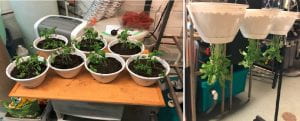
Figure 1a (left): The upright basil plants
Figure 1b (right): Some of the upside down basil plants on a garment rack


After four weeks of growth, it was observed that stems of upright plants that had been pruned on Day 1 had established pairs of offshoot stems with two or three sets of leaves. Stems of upside-down plants that had been pruned on Day 1 had established pairs of offshoot stems with only one or two sets of leaves. This suggests that the upright plants experienced increased growth compared to the upside-down plants. Figures 2 and 3 display this growth difference.
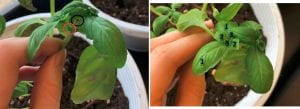
Figure 2: Pruned stem of plant 6 (upright) with 3 sets of new leaves. The black circle on the left highlights the location of the pruning cut. The red circle highlights where the new offshoot stems and leaves grew from the main stem. The sets of leaves are numbered on the right.
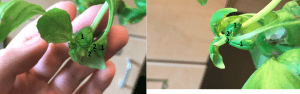
 

Figure 3: Two pruned stems from plant 11 (upside-down), each with 2 pairs of new leaves.


Several obstacles were encountered in trying to maintain healthy plants. Challenges included: growing basil during the late winter/early spring months (which is not basil’s typical growing season for this region), securing an indoor location that met the environmental needs of basil, and the presence of insects.

Due to the complications with maintaining consistently healthy plants, no formal measurements with the experimental plants have been taken at this time, but there have been several practice measurements including extracting chlorophyll and measuring the wavelengths with a spectrophotometer, staining stem cross sections with toluidine blue and observing the plant vasculature under a microscope, and experimenting with different grip set ups for tensile testing. Images of the practice stained samples have been included below in Figure 4.
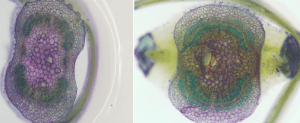
Figure 4: Two basil stem cross sections stained with toluidine blue and examined under a microscope


§

Chlorophyll wavelength measurements were taken using a spectrophotometer. I am currently reviewing published literature for additional information about the effect of a plant’s health on its chlorophyll production.

Apart from the plants being used for experimentation, an additional basil plant was purchased in order to conduct practice tensile tests and find the most effective grip set up for successful testing. Due to the available pieces of testing apparatus not having fixtures suitable for botanical samples, there were no successful practice tensile tests. In the majority of the practice tests, the stem sample slipped through the grips. Examples of this are shown in Figures 5 and 6. In Figure 5, the stem slips from the start of testing. In Figure 6, the stem starts to deform as desired, but the sample begins to slip in the middle of testing. A successful tensile testing graph would look more like Figure 7. This graph was the result of one of the practice tests; however, the sample broke right at the bottom grip (displayed in Figure 8) which is not desirable. The sample should break more towards the center of the gage length. Breaking at the grips occurs due to improper stress concentrations through the sample; the grips are exerting too much force on the sample and weakening it at the grip points. Various materials such as sand paper and rubber were used to try to create more friction between the sample and the grips without applying too much force but these attempts were not successful.
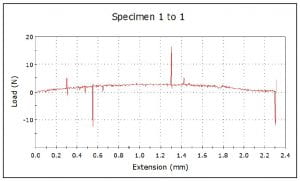
Figure 5: Load vs extension graph of a stem tensile testing sample that slips throughout testing
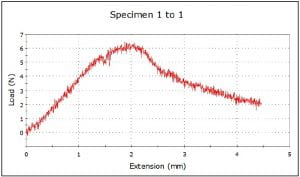
 

Figure 6: Load vs extension graph of a stem tensile testing sample that starts to deform and then begins to slip around 2mm
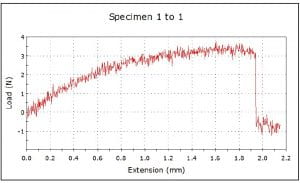
 

Figure 7: Load vs extension graph of a stem tensile testing sample. The sample deforms until breaks at about 1.9 mm
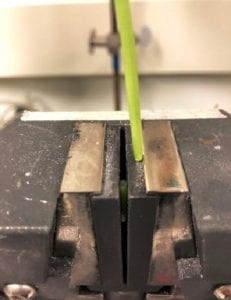
 

Figure 8: A stem tensile test sample that broke at the bottom grip


An alternative idea for tensile testing has been investigated but not yet tested. It involves wrapping the ends of the stem sample around hooks instead of compressing the ends in grips. This is a method commonly used for testing the tensile strength of string samples. This set up does not have all the necessary components, but the available components have been gathered as seen in Figure 9. There may be some need for manufacturing in order to complete the testing set up. This will be explored further during the fall 2018 semester.
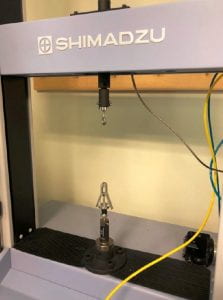
Figure 9: Top hook for future tensile tests. A bottom hook needs to be properly fashioned for this testing set up


§

The current plans for the continuation of this project consist of obtaining and maintaining a new set of plants over the summer months in order to establish a healthier set of samples. Measurements from this healthier set of plants will be collected in the fall 2018 semester.
The research grant provided to me by the Office of Undergraduate Research allowed me to obtain many necessary materials including the plants and the various materials needed to care for them. While no conclusive measurements have been collected, these funds and materials provided me the opportunity to conduct valuable troubleshooting for this project. I would not have been able to pursue researching this unique application of mechanical engineering without the support of the grant. I would like to acknowledge my advisor Dr. Tracie Ferreira for her support and guidance with this project.

Research in Phychology

The Effect of Race-Related Words on Categorical Perception of Race

By Anna Sullivan


Categorical perception (CP) refers to the psychological phenomenon that occurs when we perceive a stimulus existing along a continuum as a set of discrete categories (for a review, see Fugate, 2013). One way to conceptualize CP is to think of a rainbow and the colors it produces. While we see a range of different colors, the physical composition of the rainbow is in fact a continuous range of visible wavelengths of light (Goldstone & Hendrickson, 2009). Due to the fact that we are unable perceive these wavelengths as they are, we counteract this by forming discrete categories in order to divide such objects, or in this case colors, occurring on a spectrum. From there, we can then differentiate the colors we see based on how we perceive their differences (e.g. Bornsten, Kessen, & Weiskopf, 1976). When this happens, the differences of colors in separate categories become more prominent while the differences of colors in the same category are less pronounced (Goldstone & Hendrickson, 2009).


Portrait of Anna Sullivan

Early psychological empirical research studied how speech sounds were perceived categorically (Liberman, Harris, Hoffman, & Griffith, 1957). Due to advancing technology and computer software, work on CP has also been extended to the human face. CP has been found to be present in the perception of facial expressions (Etcoff & Magee, 1992), familiar facial identities (Beale & Keil, 1995), gender information (Campanella, Chrysochoos, & Bruyer, 2001), and emotion (Fugate, Gouzoules, & Barrett, 2010). CP has also been studied in terms of race. For example, Levin and Angelone (2002) found that similar to gender, CP was stronger for different race facial morphs than for facial morphs of the same racial group.

In addition, categorical perception of social constructs, including emotion and race, are affected by a perceiver’s conceptual knowledge, including his/her language (see Barrett, 2006; Fugate, 2013). Specifically, when the meaning of a word is activated, people show more willingness to accept non-target emotional stimuli as a category member (Fugate, Gendron, Nakashima, & Barrett, 2017). Said another way, they are less “accurate” at matching images because their categories for that item have increased to include more instances. In this manner, people are becoming more “open-minded” and flexible with what constitutes a category member.  Directly related to the current project, Tskhay & Rule (2015) showed participants perceived racially ambiguous faces as belonging to different categories when they are preceded with either the words “Black” or “White”. Therefore, semantic information (i.e. top-down information) can interact with the stimulus characteristics (i.e. bottom-up information) to create differentiated judgments.

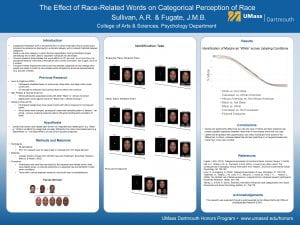
Poster of Anna Sullivan’s research project

§

The research question for this project was: how do different race-related words affect the categorical perception of race? This study sought to further expand what is known of CP of race as it is affected by race-related words. To date, no research has directly studied the categorical perception of race and language (for a review, see Timeo, Farroni, & Maass, 2017). This type of research is important because it can provide more knowledge of how race-related words (and language more broadly) can affect our perceptions of important social categories, such as race.

The objectives of this project were to examine the ways in which certain race-related words affect an individual’s processing in categorizing racially ambiguous faces. This study examined how these cognitive processes are influenced by top-down information, such as language, and work to establish an individual’s perception of race within individuals. This work can lead to a better understanding of how people “see” race in the world and how the words used to describe race can shift perception and ultimately change biases. We are all affected by external sources of information, and therefore need to continue to explore the ways in which they affect our categorization of others into social and racial groups.

Categorical perception was tested through a typical two-stage paradigm (reviewed by Fugate, 2013). The first paradigm, classification (or identification), defined a participant’s categorical boundary (i.e. the point at which an individual distinguishes an image as either one race or another). The second paradigm, discrimination, was used to test for the hallmark of CP which is an increase in the ability to discriminate between pictures previously assigned to different categories compared with pictures previously assigned to the same category, even though the physical difference between the pictures is always held constant.

Detail from Anna Sullivan’s study


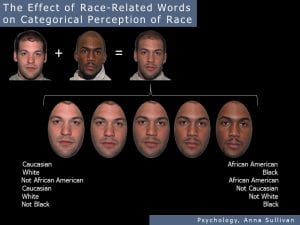
During the classification stage of this research, participants were presented with an array of racially ambiguous face stimuli that have been created using computer software (FantaMorph). These faces were created from combining two photos of different race individuals and creating systematic blends (known as morphs) which depict iterations between the two pictures Participants were then be asked to identify each stimulus as belonging to one of two categories, anchored by the picture endpoints or race-related words in different trials. We used several different race-related words to see whether a person’s threshold changes when evoking different race-related words and from when no words are evoked (match to picture condition).

During the discrimination stage of this research, participants were presented with two sequential morphs, which either span the threshold (established in part 1) or do not span the threshold (but constitute the same structural difference between the faces). The former trials were the “between-category” trials. Participants’ increased accuracy to discriminate better the “between-category” trials from the within-category is the hallmark of CP.   We predicted that when participants match to race-related words (compared to pictured endpoints), they will show increased thresholds (steeper category transitions). Moreover, the steeper transitions translated into enhanced CP, as demonstrated by participants having increased accuracy to the “between-category” pairs compared to the “within-category” pairs.

§

Although similar types of studies and experiments have been performed, this project is unique in several key ways. First, no one has performed the full CP task (both identification and discrimination) on racial morphs. Second, the facial morphs are unique and were created specifically for this study from professional face sets. Third, no one has varied how (that is to what endpoint) participants match their choices. Words are almost always used as anchors. However, in a related CP study of emotion in the lab, Dr. Fugate and her students showed that matching to pictured endpoints (rather than words) increased the transition between categories but did not change CP. In addition, we will vary the type of race-related words (e.g. “African American” and “Black” and “not White” vs. “European American” and “White” vs. “Not Black”) to see if specific identifiers affect race perception differently.

Results from the identification portion of this research showed that language produces significant effects on race perception. Data analysis is still underway for the discrimination task, as well as the survey participants completed. This project was presented at both the UMass Amherst Undergraduate Research Conference and the PSI CHI Research Conference. It was also awarded second place at the 2018 OUR Undergraduate 3 Minute Thesis competition. I am grateful to my advisor Dr. Jennifer Fugate for her guidance and to the OUR for the financial support needed for this research.


Sources

Barrett, L. F. (2006a). Are emotions natural kinds? Perspectives on Psychological Science, 1, 28-58.

Barrett, L.F. (2006b). Solving the emotion paradox: Categorization and the experience of emotion. Personality and Social Psychology, 10, 20-46.

Beale, J.M., & Keil, C.F. (1995). Categorical effects in the perception of faces. Cognition, 57, 217-239.

Bornstein, M.H., Kessen, W., & Weiskopf, S. (1976). Color vision and hue categorization in young human infants. Journal of Experimental Psychology: Human Perception and Performance, 2, 115-129.

Campanella, S., Chrysochoos, A., & Bruyer, R. (2001). Categorical perception of facial gender information: Behavioural evidence and the face-space metaphor. Visual Cognition, 8, 237-262. doi: 10.1080/13506280042000072

Etcoff, N.L., & Magee, J.J. (1992). Categorical perception of facial expressions. Cognition, 44, 227-240.

FantaMorph. (2017). http://www.fantamorph.com/index.html

Fugate, J.M.B. (2013). Categorical perception for emotional faces. Emotion Review, 5, 84-89. doi: 10.117/1754073912451350

Fugate, J.M.B., Gendron, M., Nakashima, S.F., & Barrett, L.F. (2017). Emotion words: Adding face value. Emotion. doi: 10.1037/emo0000330

Fugate, J.M.B., Gouzoules, H., & Barrett, L.F. (2010). Reading chimpanzee faces: Evidence for the role of verbal labels in categorical perception of emotion. Emotion, 10, 544-554. doi: 10.1037/a0019017

Goldstone, R. L., & Hendrickson, A. T. (2010), Categorical perception. WIREs Cogni Sci, 1: 69–78. doi:10.1002/wcs.26

Levin, D. & Angelone, B. (2002). Categorical perception of race. Perception, 31, 567-578. doi: 10.1068/p3315

Liberman, A.M., Harris, K.S., Hoffman, H.S., & Griffin, B.C. (1957). The discrimination of speech sounds within and across phoneme boundaries. Journal of Experimental Psychology, 54, 358-368.

Timeo, S., Farroni, T., & Maass, A. (2017). Race and color: Two sides of the same story? Development of biases in categorical perception. Child Development, 88, 83-102. doi: 10.1111/cdev.12564

Tskhay, C. & Rule, N. (2015). Semantic information influences race categorization from faces. Personality and Social Psychology Bulletin, 41, 769-778. doi: 10.1177/0146167215579053